Immersive Metaverse applications demand infrastructures that balance performance, privacy, and environmental sustainability requirements that centralized models struggle to satisfy. We introduce MetaFed, a decentralized federated learning (FL) framework that integrates multi-agent reinforcement learning (MARL), privacy-preserving optimization, and carbon-aware orchestration. MetaFed enables scalable, intelligent, and environmentally responsible resource allocation for federated Metaverse systems.
Our framework introduces reinforcement-driven orchestration through a multi-agent RL engine with a reward function balancing accuracy (ΔAt), efficiency (ΔEt), and emissions (CCO₂,t). We enhance FL aggregation with homomorphic encryption and (ε=1.2, δ=1×10⁻⁵)-differential privacy for biometric/behavioral data protection. The green-aware optimization integrates carbon intensity into orchestration decisions through correction terms in Q-values.
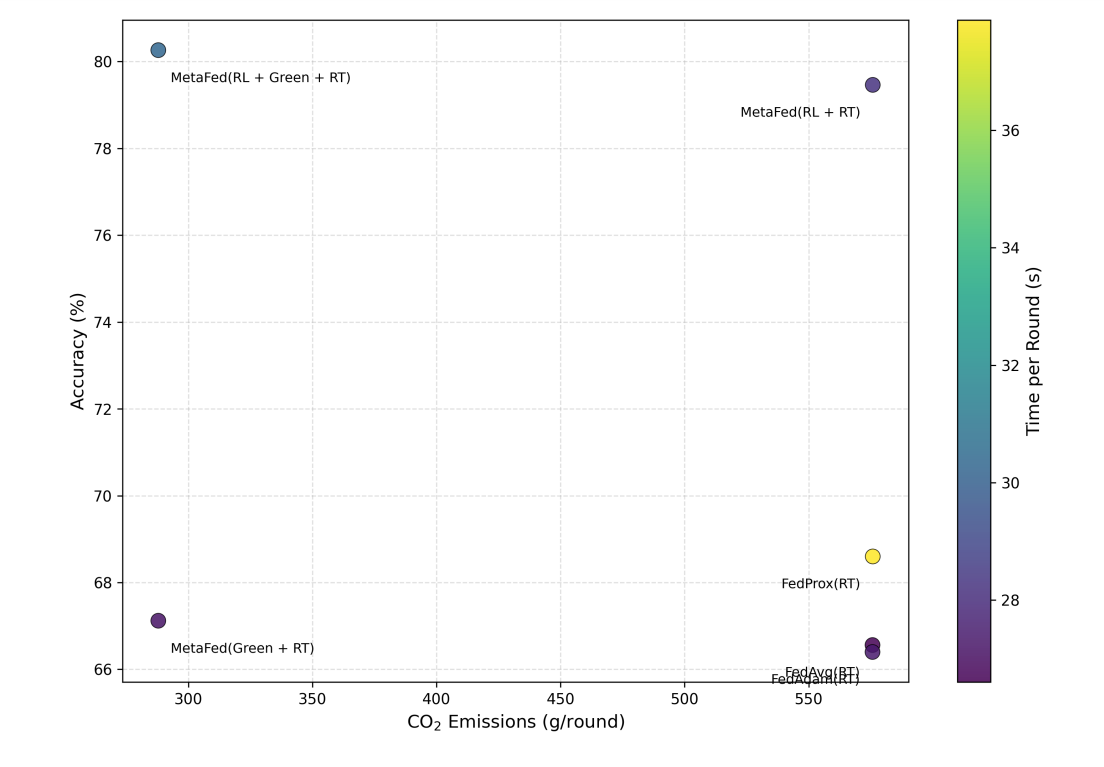
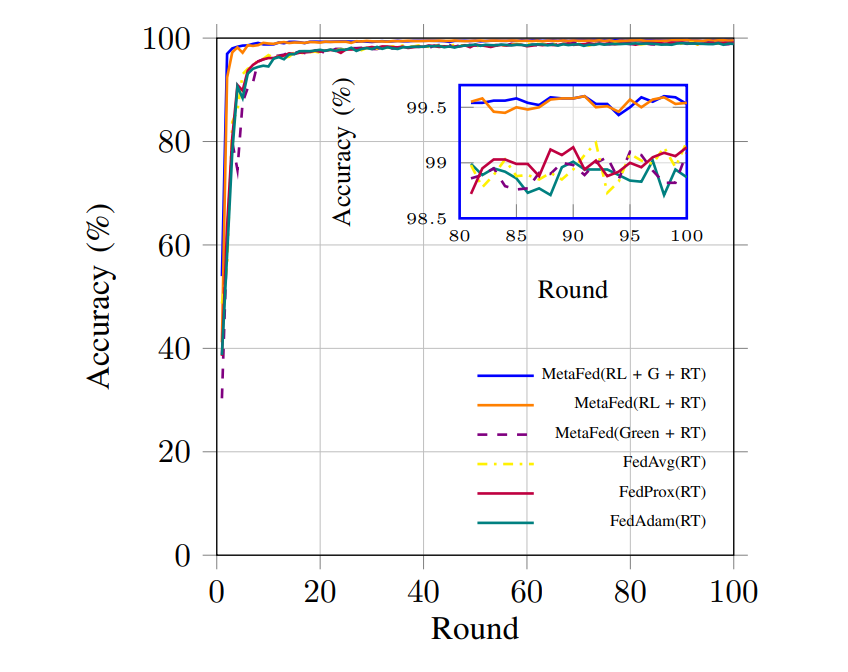
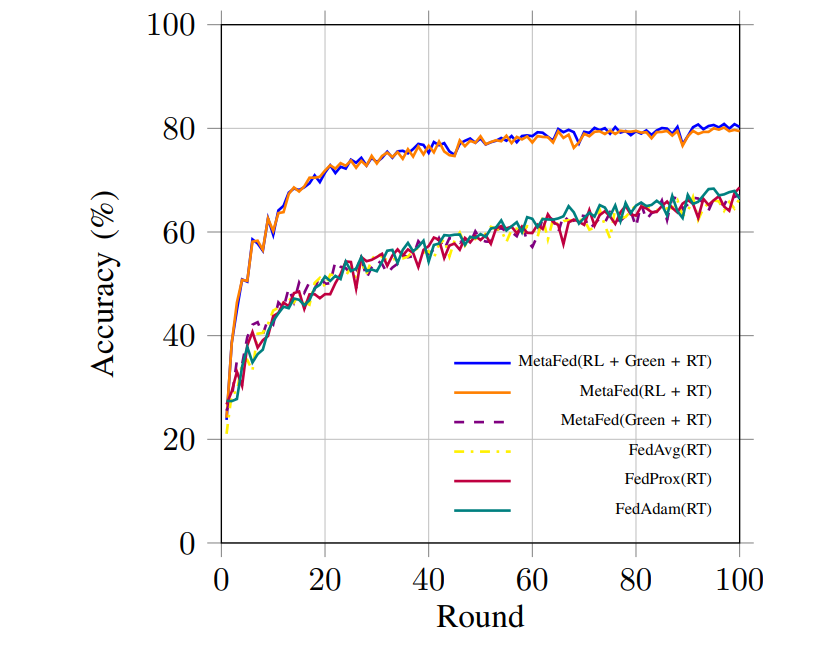
Experimental results demonstrate that on MNIST, MetaFed achieves 99.60% accuracy with 41.6% lower CO2 emissions per round compared to FedAvg (45,846 g vs. 57,755 g). On CIFAR-10, MetaFed reaches 80.26% accuracy (+20.5% over FedAvg) while cutting emissions per round by 49.9% (287.9 g vs. 575.8 g). Across benchmarks, MetaFed consistently delivers higher accuracy with ~20% less cumulative emissions, validating its multi-objective optimization strategy.
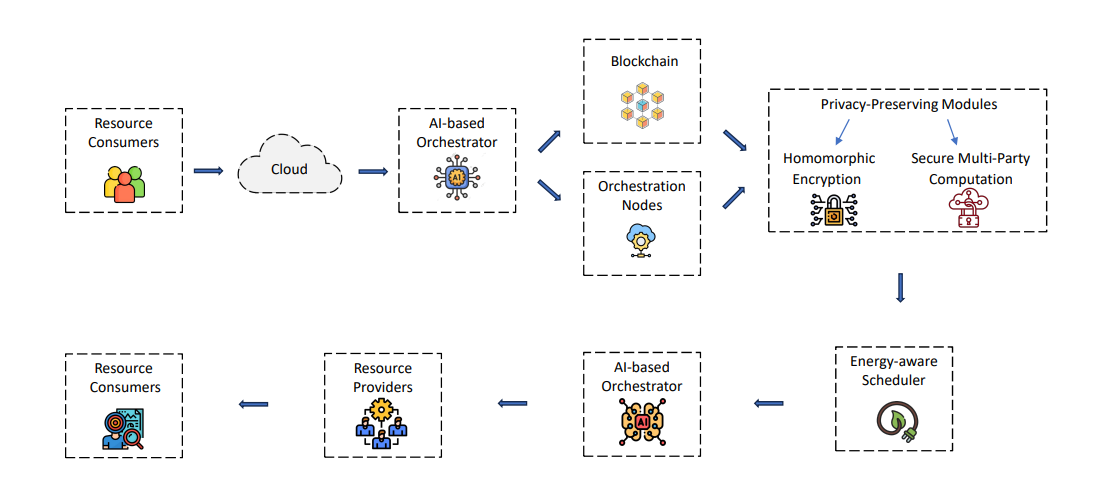
Multi-Agent Reinforcement Learning Framework: MetaFed is the first FL framework explicitly designed to optimize performance, privacy, and sustainability for Metaverse infrastructures through MARL-based orchestration with carbon-aware scheduling.
Reinforcement-Driven Orchestration: Novel multi-agent RL engine with reward function (Equation 4) balancing accuracy (ΔAt), efficiency (ΔEt), and emissions (CCO₂,t) for intelligent resource allocation.
Green-Aware Optimization: Correction term in Q-values (Equation 5) integrates carbon intensity into orchestration decisions, enabling priority function (Equation 9) for dynamic allocation to greener nodes.
Enhanced Privacy Protection: FL aggregation (Equations 6-7) enhanced with homomorphic encryption and (ε=1.2, δ=1×10⁻⁵)-differential privacy, ensuring compliance under sensitive biometric/behavioral data.
Multi-Agent Reinforcement Learning: MetaFed employs a sophisticated MARL engine that coordinates learning across distributed metaverse nodes while optimizing for multiple objectives including accuracy, efficiency, and environmental impact.
Carbon-Aware Orchestration: The system incorporates intelligent carbon-aware scheduling with priority functions that dynamically allocate tasks to greener nodes, reducing lifecycle emissions while maintaining performance standards.
Privacy-Preserving Aggregation: Enhanced FL aggregation strategies with homomorphic encryption and differential privacy (ε=1.2, δ=1×10⁻⁵) ensure robust protection of sensitive biometric and behavioral data in metaverse environments.
Green-Aware Q-Learning: Novel correction terms in Q-values integrate carbon intensity data into reinforcement learning decisions, enabling environmentally conscious resource allocation without sacrificing model performance.
MNIST Dataset Results: MetaFed achieves 99.60% accuracy with 41.6% lower CO2 emissions per round compared to FedAvg. Cumulative emissions reduced from 57,755 g to 45,846 g (~20.6% improvement) while maintaining superior accuracy.
CIFAR-10 Dataset Results: MetaFed reaches 80.26% accuracy (+20.5% improvement over FedAvg) while cutting emissions per round by 49.9% (287.9 g vs. 575.8 g), demonstrating significant efficiency gains on complex datasets.
Multi-Objective Optimization: Across all benchmarks, MetaFed consistently delivers higher accuracy with approximately 20% reduction in cumulative emissions, validating the effectiveness of the MARL-based orchestration strategy.
Privacy and Sustainability: The framework maintains robust privacy guarantees through differential privacy mechanisms while achieving competitive training times, proving the practical viability of green federated learning for metaverse applications.
@misc{yagiz2025metafeddecentralizedfederated,
title={MetaFed: A Decentralized Federated Learning Framework for Sustainable Metaverse Applications},
author={Muhammet Anil Yagiz and Zeynep Sude Cengiz and Polat Goktas},
year={2025},
eprint={2508.17341},
archivePrefix={arXiv},
primaryClass={cs.LG},
url={https://arxiv.org/abs/2508.17341},
}